Knowing which sign and house each planet occupies already says a lot about a birth chart. But planets do not work in isolation. Your way of thinking talks to your way of feeling; your drive to act bumps into, or leans on, your need for security. Aspects are how astrology describes these conversations. And, unlike what many people imagine, there is nothing occult about them: they are angles, measured in degrees, between points in the sky.
What an aspect is
The zodiac is a circle of 360°. Each planet occupies a position on that circle, called ecliptic longitude. A Sun at 10° Taurus, for example, is at longitude 40°, because Taurus begins at 30°. A Moon at 10° Leo is at longitude 130°. The distance between the two is 90°.
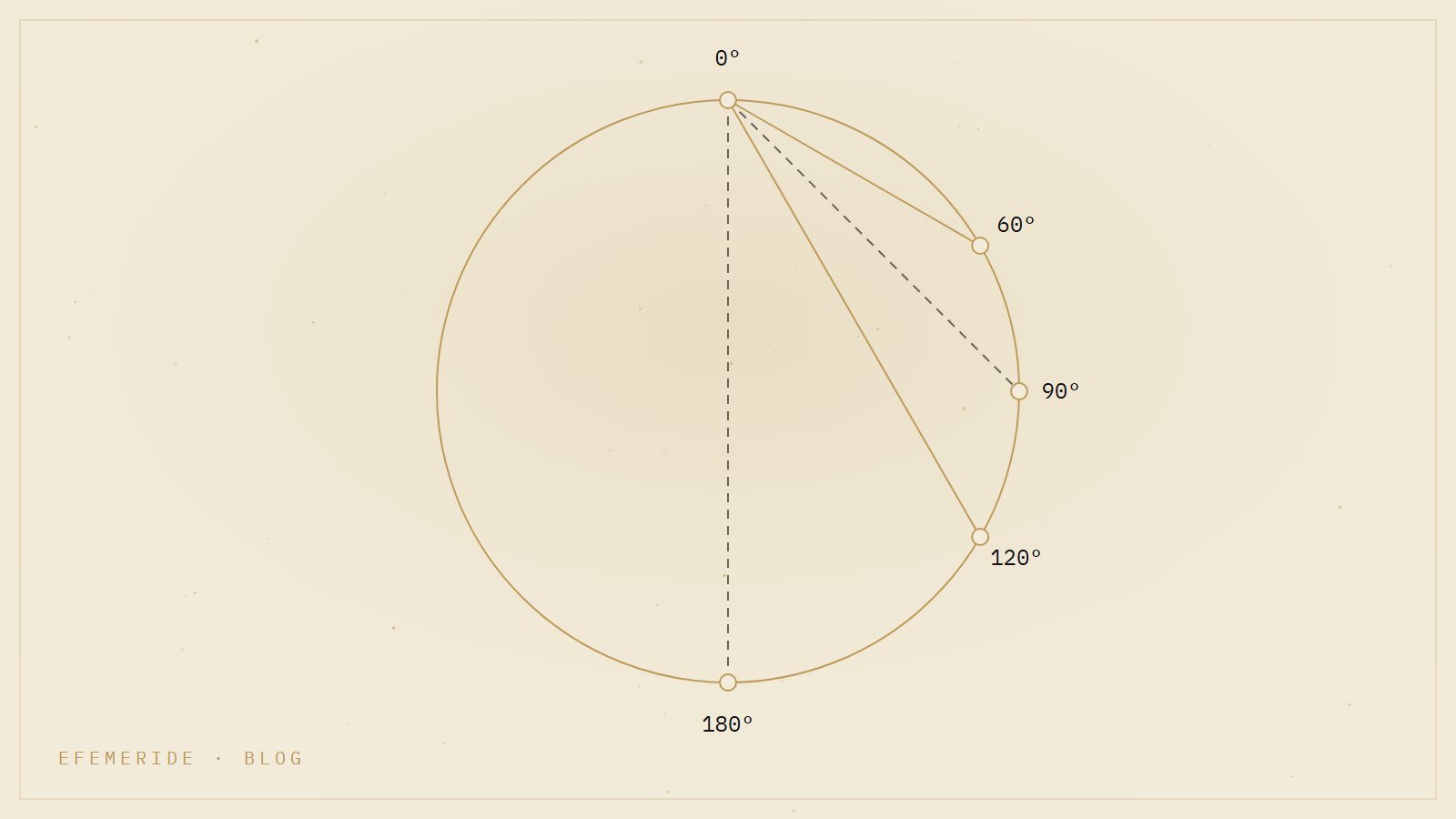
When the distance between two planets comes close to certain specific angles, they are said to be in aspect. The five main aspects, called the major aspects, come from dividing the circle by simple whole numbers: by 1, by 2, by 3, by 4 and by 6.
The five major aspects
Conjunction, 0°
Two planets at the same degree, or very close to it. The functions they represent blend and act together, almost as a single voice. A conjunction between Mercury and Mars, for example, tends to join thought and action: quick ideas, direct speech, a taste for debate. The quality of a conjunction depends a lot on the planets involved.
Sextile, 60°
One sixth of the circle. It usually links signs of compatible elements, such as fire and air, or earth and water. The sextile is read as an opportunity: an ease that is there, but that tends to pay off more when you use it actively.
Square, 90°
One quarter of the circle. It links signs of the same modality, such as two cardinal signs, and usually of elements that do not mix easily. The square describes friction: two functions pulling in different directions and asking for adjustment. That friction is often the engine of growth and action in the chart.
Trine, 120°
One third of the circle. It usually links signs of the same element. The trine describes flow: the two functions cooperate with no apparent effort. It is a natural resource, almost a talent. The less visible side is that what flows easily is sometimes underdeveloped, precisely because it demands no effort.
Opposition, 180°
Half of the circle. The two planets sit in opposite signs, such as Aries and Libra. The opposition speaks of polarity: two needs that seem to compete and that, over time, can learn to balance each other. It often shows up in relationships, when one end is projected onto another person.
What an orb is
Two planets are rarely exactly 90° or 120° apart. The orb is the difference between the actual angle and the exact angle of the aspect. If Venus is at 12° Cancer and Saturn at 15° Libra, the distance is 93°. The exact square would be 90°, so the orb is 3°.
Each school defines how wide an orb can be for an aspect to count. It is common to give a wider margin to aspects involving the Sun and the Moon, and a narrower margin to the sextile than to the conjunction or the opposition. There is no universal number. What there is, instead, is a principle almost every school shares: the smaller the orb, the stronger and clearer the aspect tends to be. A trine with a 1° orb usually weighs more than a trine with a 7° orb.
That is why it is worth looking at the number, not just the name of the aspect. In the app, each aspect appears with its orb next to it, and you can see why one aspect was counted and another was not.
An aspect is not a sentence. It is a measure of how close two parts of you are to the same conversation.
Applying and separating
Seen from Earth, the planets move at different speeds. The Moon moves about 13° per day, the Sun about 1° per day, and the outer planets advance very slowly. So, at any given moment, an aspect may be forming or coming apart.
- Applying aspect: the faster planet is still approaching the exact angle. The orb is shrinking.
- Separating aspect: the faster planet has already passed the exact angle and is moving away. The orb is growing.
Many traditions read an applying aspect as something under construction, a tendency gaining strength, and a separating aspect as something already lived, which tends to be integrated more naturally. It is a nuance, not a rigid rule.
There is an astronomical detail that complicates the math: retrograde motion. During certain periods, a planet seems to move backward in the sky. This is apparent motion, caused by the difference in speed between Earth and the planet in their orbits, as when one car overtakes another and the slower one seems to drift back. When a retrograde planet is involved, an aspect that looked separating may start approaching again. The calculation accounts for this by comparing the actual speed of each planet at that moment.
Hard does not mean bad
It is common to split aspects into soft ones, like the sextile and the trine, and hard ones, like the square and the opposition. The conjunction depends on the planets. This division is useful, but it is often misunderstood.
A hard aspect is not a sign of bad luck, guaranteed suffering or something wrong with you. It points to a place where two functions do not fit together at first and call for conscious work. That work usually builds skill. A square between Mars and Saturn, for example, can describe frustration at a sense of being held back, but also a great capacity for persistence and discipline in action.
In the same way, soft aspects are no guarantee of an easy life. A chart full of trines can describe talents that sit still for lack of challenge. In practice, most charts have a mix of both kinds, and that mix is what gives the story its movement.
To close
Aspects are geometry applied to the sky of your birth: angles between planets, measured in degrees, with a tolerance margin called the orb. Learning to read this geometry helps you see the chart as a living system, in which every part influences the others. Start with the aspects that have the smallest orbs, notice whether they involve the Sun, the Moon or the Ascendant, and remember that tension, in the chart, usually means energy in motion.