When two people meet, something happens that neither of them would explain alone. There are instant affinities, frictions that keep coming back, topics that flow and others that always stall. Synastry is the part of astrology that tries to describe this conversation by placing two birth charts side by side. It does not tell you whether a relationship will work. It shows where the two skies touch, at what angle and with what intensity, and offers a vocabulary for thinking about what is already happening between you. And it works for any bond: love, friendship, family, business partnership.
What synastry is
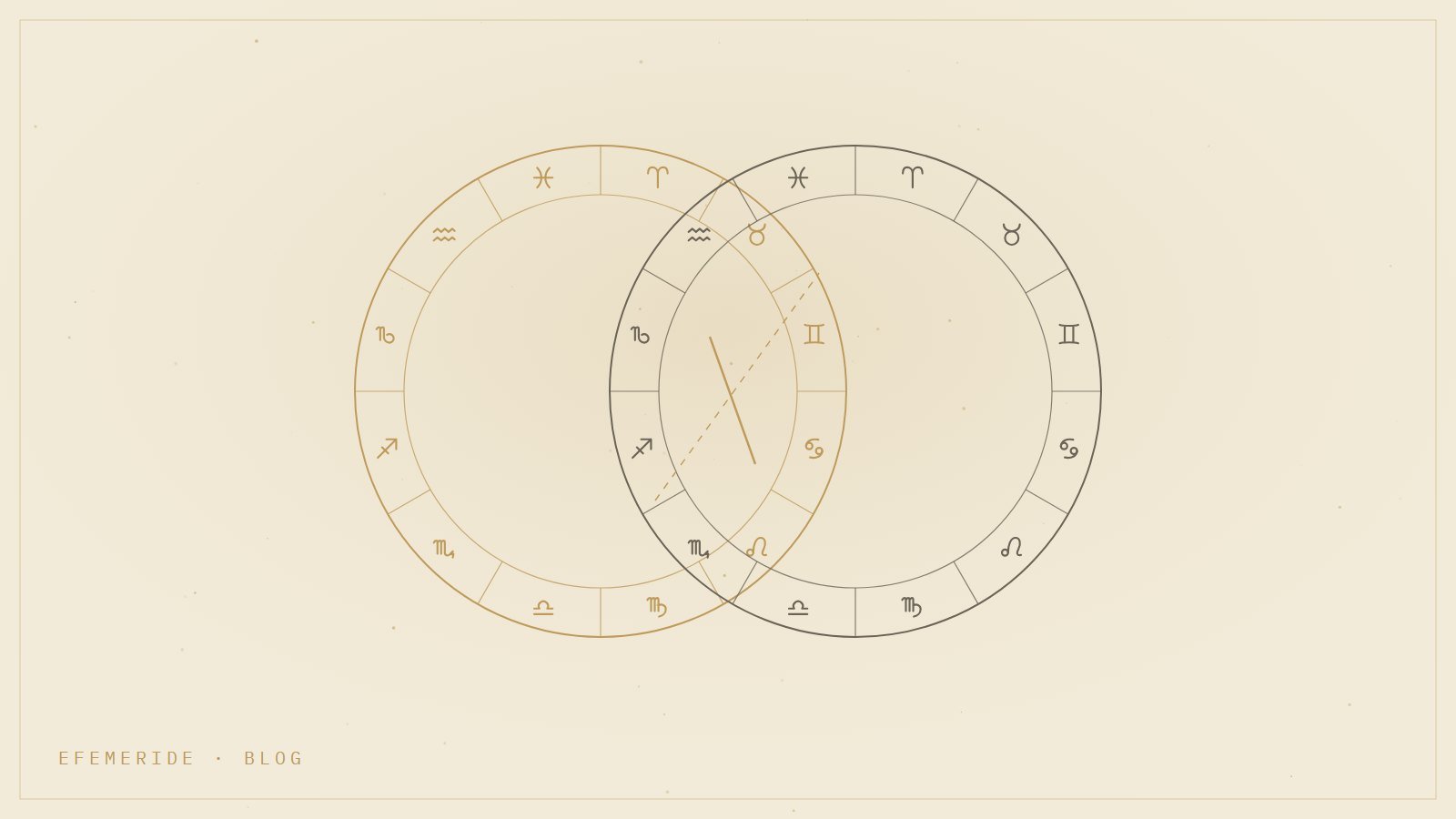
Synastry is the comparison of two birth charts. Each chart records the positions of the planets in the tropical zodiac and the houses at the moment and place each person was born. In synastry, what matters are the relationships between the points of one chart and the points of the other: one person's Sun near the other's Moon, one person's Venus forming an angle with the other's Mars, and so on.
The method is the same as reading an individual chart, with one difference: the aspects now connect two skies. That is why synastry requires the birth data of both people. Without the birth time, you can still compare most of the planets, but the Ascendant, the houses and often the exact degree of the Moon remain uncertain, because the Moon moves about 13° a day.
The points that weigh most
The whole chart takes part, but some points usually carry more weight when reading a relationship. Tradition pays special attention to these:
- Sun. Identity, what each person seeks to express. Contacts with the other's Sun tend to feel like recognition or, in tense angles, like a contest for space.
- Moon. Emotional needs, what brings security, the way of caring and wanting to be cared for. Contacts with the Moon usually speak of comfort and everyday life together.
- Venus. Affection, taste, pleasure, the way of getting close. It matters in love, but also in friendship: it says a lot about what you enjoy doing together.
- Mars. Desire, initiative, the way of fighting and acting. Contacts with Mars bring energy, which can turn into enthusiasm or friction.
- Saturn. Commitment, limits, responsibility, time. It is the planet tradition associates with durability. It can give a relationship structure or be felt as weight and pressure.
- Ascendant. How each person comes across and is perceived. When one person's planet falls on the other's Ascendant, the contact is usually noticed right from the start.
The slower planets, such as Uranus, Neptune and Pluto, stay in the same sign for years. Between people of the same generation, they tend to sit in similar positions, so they matter more when they touch a personal point in the other chart than when they simply repeat in both.
Aspects between charts
An aspect is a specific angle between two points of the zodiac. In synastry, you measure the angle between a planet in one chart and a planet in the other. The main aspects are:
- Conjunction (0°). Both points in the same place. A fusion of themes, intensity, for good and for friction.
- Sextile (60°). Ease and opportunity, a contact that usually flows when you invest in it.
- Square (90°). Tension, a difference in pace, something that calls for adjustment. It is often where the relationship grows the most.
- Trine (120°). Harmony, naturalness. Comfortable, sometimes so comfortable that it goes unnoticed.
- Opposition (180°). Polarity, attraction and contrast at the same time. It asks for balance between two ways of being.
No angle is exact all the time, which is why there is the orb: the margin, in degrees, within which an aspect is considered active. In synastry, many schools use slightly smaller orbs than in natal reading, because there are far more possible combinations between two charts. An aspect with a 1° orb is much more striking than one with a 6° orb. Knowing the orb helps you tell a strong contact from a subtle one.
In synastry, what matters is not whether the charts match, but where they touch, at what angle and how closely.
Houses: where the other person lands in your life
With both birth times, you can see which house of your chart the other person's planets fall into. Tradition reads this as the area of your life that person tends to activate. Someone's Venus in your 4th house suggests affection tied to home and family; someone's Saturn in your 10th house, a relationship linked to career, demands and responsibility.
The composite chart
Synastry compares two charts. The composite chart does something else: it creates a third chart that represents the relationship itself. The most common method calculates the midpoint between each pair of planets. If your Sun is at 10° Aries and the other person's Sun is at 10° Gemini, the composite Sun sits at 10° Taurus, exactly halfway.
Repeating this for every planet and angle produces a chart that tradition reads as the identity of the bond: what the relationship seeks, where it is strong, where it tends to stumble. There is also another method, which uses the midpoint in time and space between the two births, but the logic is similar. Synastry speaks of how each person experiences the other; the composite, of what the two build together.
Why no number decides a relationship
It is tempting to look for a final score, a percentage that says whether it is worth it. Some services deliver exactly that. In the app, synastry comes with an index, but it is explained: each part of the number points to the aspects and orbs that formed it, so you can see what weighed and why. Even so, the index is a summary, not a verdict.
- Every chart has tension. A pair of charts with no square or opposition at all is rare, and would not even be desirable. Points of friction are also where two people learn from each other.
- Harmony does not guarantee getting along. Many trines can describe comfort, but a relationship also depends on choices, conversations and care.
- Context changes everything. The same contact between Mars and Saturn can feel like shared discipline in a business partnership and like pressure in a romance. The bond sets the tone.
- People change. The birth chart is fixed, but the way each person lives their own chart matures over time.
Use synastry as a map for conversation, not as proof of compatibility. It can help you name what you already sense, understand why certain topics spark so much and value what flows without effort.
To close
Synastry looks at two skies at once and asks where they meet. Sun, Moon, Venus, Mars, Saturn and the Ascendant usually speak loudest; aspects, with their orbs, show the quality and strength of each contact; the composite chart shows the relationship as a third character. None of this replaces the experience of being with someone. It works the same way for love, friendship and family: as a lens that describes tendencies and potential, and leaves the decision with the people living the relationship.