Look at the sky on consecutive nights and you will notice the Moon is never the same. It changes shape, rising time and position among the stars. There is no mystery in that change: it is geometry. The Moon circles the Earth, the Sun always lights half of it, and what you see from here is the share of that lit half turned toward you. Astrology takes this cycle, which anyone can follow with the naked eye, and uses it as a symbolic clock for starting, growing, harvesting and letting go. Understanding the calculation makes that clock more useful, not less beautiful.
A cycle that repeats every 29.5 days
From one New Moon to the next there are, on average, about 29.5 days. This is the synodic month. It is longer than the time the Moon takes to complete one lap relative to the stars, roughly 27.3 days, because in that interval the Earth has also moved along its orbit around the Sun, and the Moon has to travel a little further to line up with it again.
What defines the phase is the angle between the Sun and the Moon as seen from Earth. In astrology this angle is measured along the zodiac, in degrees of longitude. When the Sun and Moon share the same degree, it is a New Moon. When they are 180° apart, on opposite sides of the sky, it is a Full Moon. In between, the Moon pulls away from the Sun by about 12° to 13° a day, and that distance is the exact measure of the cycle.
The phase of the Moon is not a mood of the sky: it is the distance between the Moon and the Sun, and that distance can be measured in degrees.
The eight phases and what tradition links to each one
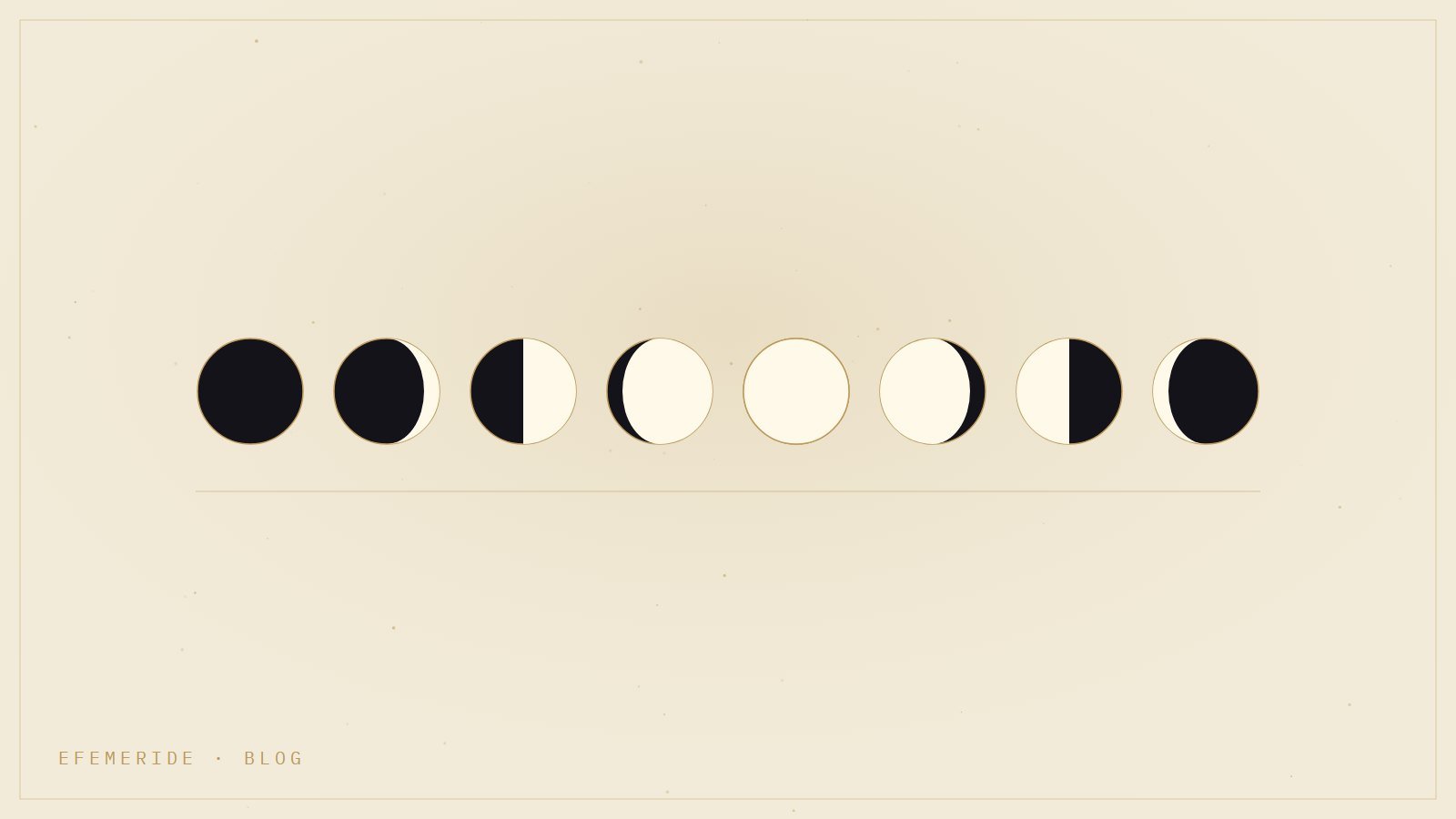
The everyday calendar talks about four phases. The astrological tradition divides the cycle into eight, each covering a 45° stretch and lasting, on average, a little over three and a half days. The associations below are symbolic. They describe an arc of growth and withdrawal, not a list of things you must do.
- New Moon (0° to 45° from the Sun). The Moon is practically invisible, lost in the Sun's glare. Tradition reads this moment as a seed: intention, a quiet beginning, something that has no shape yet.
- Waxing Crescent (45° to 90°). The first sliver appears in the late afternoon, just after sunset. It is linked to early effort, the stage when an idea starts asking for concrete steps.
- First Quarter (90° to 135°). Half the disk is lit. A 90° angle is a square, and tradition ties this phase to decisions, adjustments and the need to face whatever is stuck.
- Waxing Gibbous (135° to 180°). The Moon is nearly full. It is associated with refinement: reviewing, improving, getting ready for what is about to become visible.
- Full Moon (180° to 225°). Sun and Moon in opposition; the Moon rises as the Sun sets. The traditional reading is culmination and clarity: what was in motion becomes visible, for better and for the uncomfortable.
- Waning Gibbous, or Disseminating (225° to 270°). The light begins to shrink. Tradition speaks of sharing what you have learned, passing it on, teaching.
- Last Quarter (270° to 315°). Half lit again, now the opposite side. Another square, read as a course review: what stays and what goes.
- Waning Crescent, or Balsamic (315° to 360°). The final sliver, visible only before dawn. It is linked to rest, release and preparation for the next cycle.
Notice that each phase has a visible basis. The Waxing Crescent only shows up early in the evening because it sits a few degrees east of the Sun and sets shortly after it. The Waning Crescent only shows up before dawn for the opposite reason. You do not need to believe anything to check this: just look at the sky at the right time.
The Moon moving through the signs
Besides the phase, there is the sign the Moon is in. These are two different pieces of information. The phase depends on the distance from the Sun; the sign depends on the Moon's position in the tropical zodiac, the one that begins at the point where the Sun crosses the celestial equator at the March equinox.
The Moon travels through all twelve signs in a little over 27 days, which gives about two and a half days in each sign. It is the fastest-moving body in the chart, which is why tradition links it to the emotional weather of the moment, to the body's needs and to what calls for care. Some common readings:
- The Moon in fire signs (Aries, Leo, Sagittarius) is usually read as a time of more drive and eagerness to act.
- In earth signs (Taurus, Virgo, Capricorn), the traditional tone is concrete: routine, body, organization.
- In air signs (Gemini, Libra, Aquarius), the emphasis shifts to conversation, exchange and ideas.
- In water signs (Cancer, Scorpio, Pisces), to sensitivity, memory and bonds.
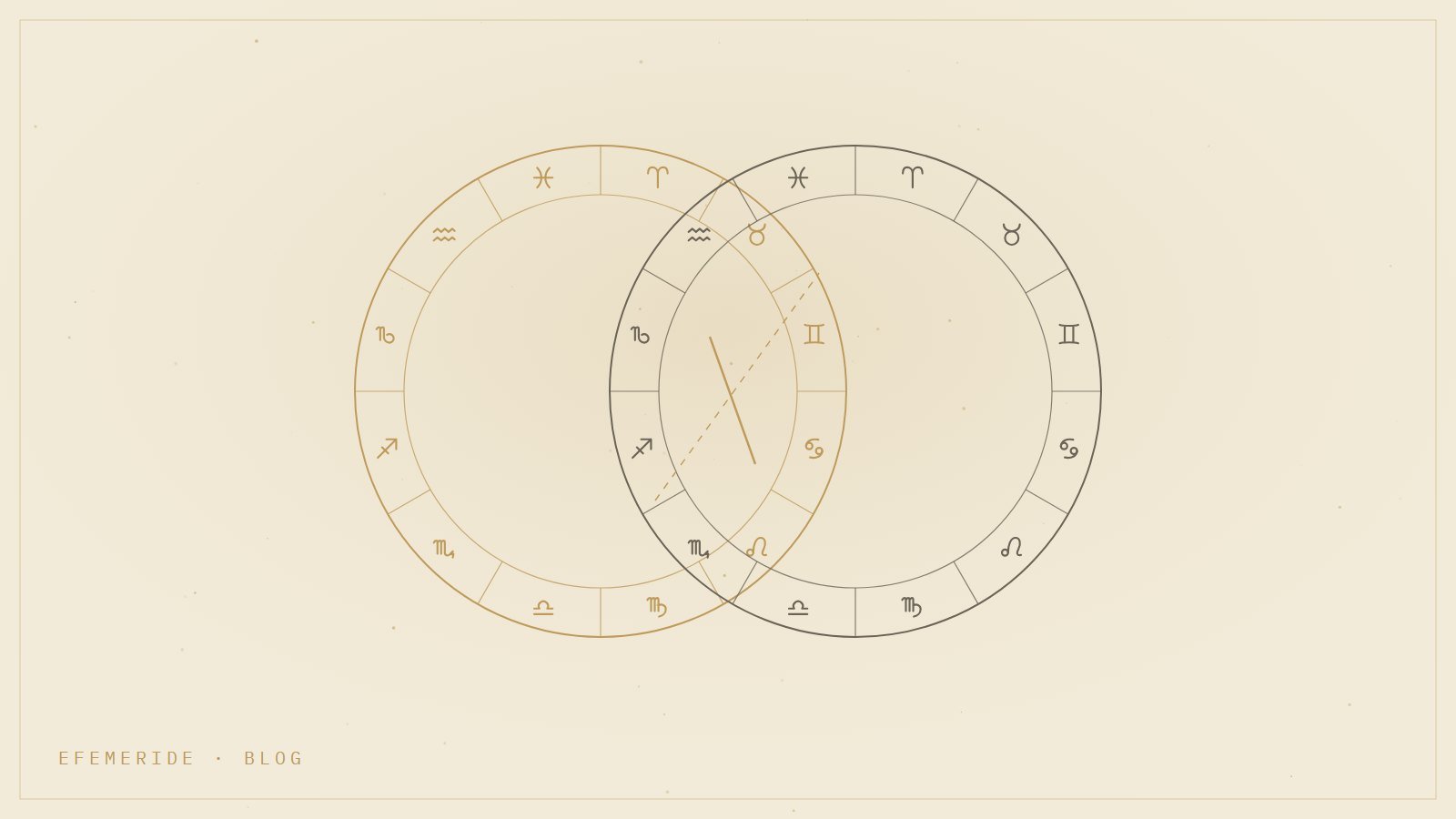
Phase and sign combine. A Full Moon in Cancer happens with the Sun in Capricorn, because a Full Moon is an opposition and those two signs are opposite each other in the zodiac. That is why each Full Moon of the year falls on a different axis of signs. In the app's Today screen, the Moon's phase and sign appear side by side, with the degree of each and the angle to the Sun, so you can see where the reading comes from.
And the Moon in your birth chart
In your birth chart, the Moon also has a phase. If you were born with the Moon 100° from the Sun, you were born under a First Quarter Moon. Some schools of astrology use this natal phase as one more layer for reading your style of starting and finishing things.
How to observe your own rhythm without rigid rules
It is common to find lists telling you what to do in each phase: cut your hair while the Moon waxes, start projects at the New Moon, wrap things up as it wanes. These lists are part of popular culture and can be fun, but it is worth treating them as suggestions, not law. Real life does not stop every three and a half days, and no phase forbids anything.
A more honest path is observation. A few simple ways to start:
- Take notes for two or three cycles. One line a day is enough: how your energy, mood and sleep felt. At the end, compare with the phases. You may find a pattern, or none, and both answers are information.
- Use the New Moon as a reminder. Every 29.5 days, it offers a natural date to review what you want to cultivate. The value lies less in the phase and more in the habit of stopping to think.
- Use the Full Moon as a checkpoint. Two weeks later, what you planted has already shown something. It is a good moment to ask what is working.
- Watch the real sky. Knowing where and when the Moon appears reconnects the symbol to the phenomenon.
If a pattern shows up, it is yours, and you decide what to do with it. If it does not, the Moon is still a great calendar for pauses and fresh starts. Here, astrology describes tendencies and offers a vocabulary; you are the one who chooses the rhythm.
To close
The phases of the Moon are one of the few astrological cycles you can follow without any instrument. Knowing that each phase matches an angle between the Moon and the Sun, that the cycle lasts about 29.5 days and that the Moon changes sign every two and a half days removes the sense of mystery and puts something firmer in its place: a sky you can check. From there, tradition becomes a lens, not a rule. Look, take notes, compare, and let your rhythm show itself in its own time.